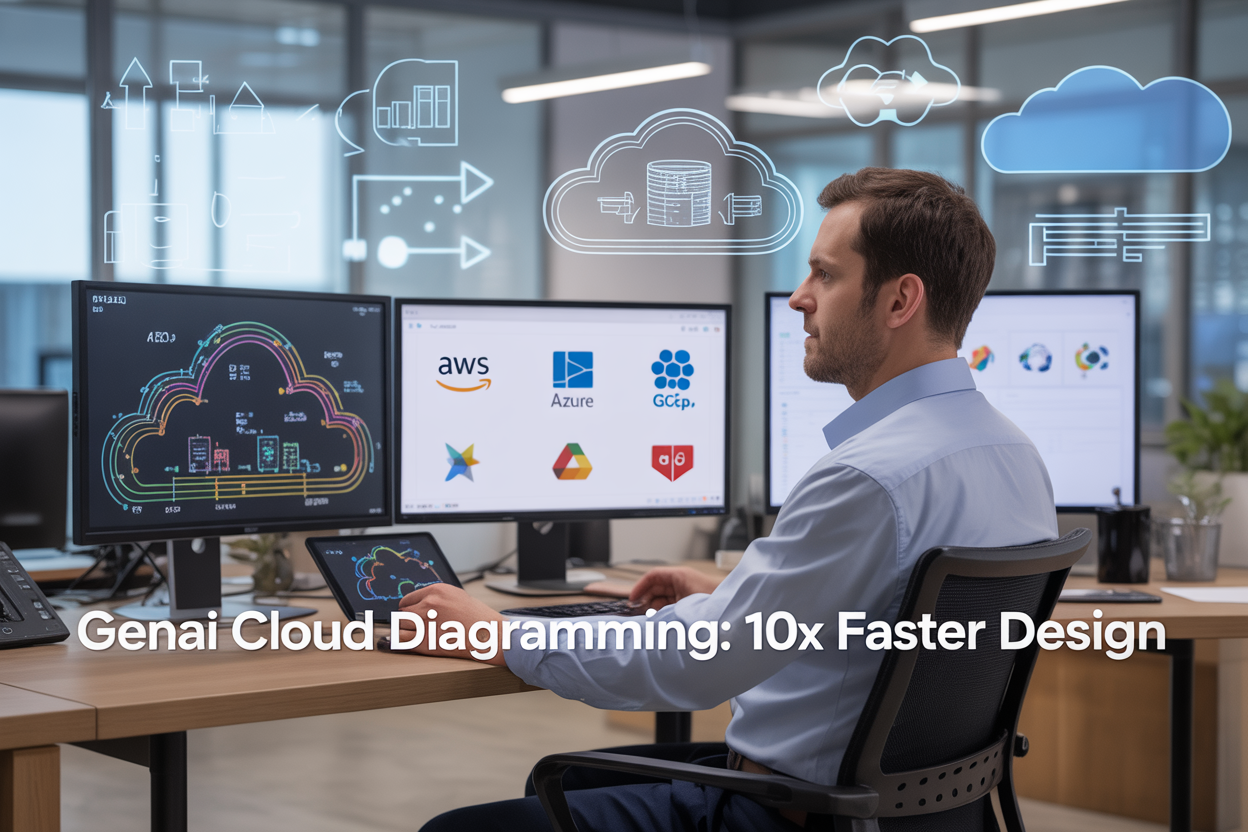
Cloud architects and DevOps engineers waste countless hours creating and updating infrastructure diagrams manually. Traditional cloud diagramming methods can’t keep pace with rapid deployment cycles across AWS, Azure, and GCP environments. GenAI architecture design tools are changing this reality by automating diagram creation and delivering AI-powered cloud tools that slash design time from days to hours.
This guide targets cloud architects, infrastructure engineers, and DevOps teams looking to accelerate their workflow with automated cloud design tools. You’ll discover how generative AI cloud platforms transform cloud infrastructure visualization and why leading teams report 10x faster diagram creation.
We’ll explore the speed acceleration benefits these AI architecture acceleration tools deliver across major cloud platforms, examine advanced features that set modern cloud diagram generation apart from legacy methods, and share real-world success stories from teams already using cloud architecture automation to streamline their design process.
Current Challenges in Traditional Cloud Architecture Diagramming

Time-consuming manual diagram creation processes
Traditional cloud diagramming demands architects to manually place, connect, and configure hundreds of components across complex infrastructures. Teams spend weeks creating comprehensive AWS, Azure, or GCP diagrams, laboriously dragging icons, adjusting connections, and ensuring visual consistency. This manual approach consumes valuable time that could be spent on strategic architecture decisions rather than tedious visual documentation tasks.
Complex multi-cloud environment visualization difficulties
Multi-cloud architectures present unique visualization challenges as architects struggle to represent interconnected services across different platforms. Creating coherent diagrams that accurately depict AWS Lambda functions communicating with Azure databases while leveraging GCP analytics becomes increasingly complex. Standard diagramming tools lack native understanding of cross-cloud relationships, forcing architects to manually research compatibility, design custom connectors, and constantly verify architectural accuracy across multiple cloud provider documentation sets.
Version control and collaboration bottlenecks
Architecture teams face significant collaboration hurdles when multiple stakeholders need to review, modify, or approve cloud infrastructure designs. Traditional tools create version control nightmares where architects lose track of changes, struggle with conflicting modifications, and spend excessive time consolidating feedback from distributed teams. File-based diagram sharing leads to confusion about which version represents the current approved architecture, while simultaneous editing often corrupts diagrams or overwrites critical design decisions.
Steep learning curves for new cloud services
Cloud platforms continuously release new services, requiring architects to constantly learn updated visual representations, understand service relationships, and master new diagramming conventions. Staying current with AWS’s 200+ services, Azure’s expanding portfolio, and GCP’s evolving offerings becomes overwhelming when each requires specific visual knowledge. Teams waste time researching proper diagram symbols, service dependencies, and best practice representations instead of focusing on optimal architecture design and implementation strategies.
Understanding GenAI-Powered Cloud Diagramming Tools

Natural Language Processing for Architecture Requirements
Modern GenAI-powered cloud diagramming tools transform how architects communicate design intentions by processing plain English descriptions and converting them into structured cloud infrastructure components. These AI systems understand technical terminology across AWS, Azure, and GCP platforms, automatically interpreting requirements like “create a scalable web application with load balancing and database clustering” into precise architectural elements. The natural language processing capabilities eliminate the need for complex configuration files or technical syntax, allowing architects to focus on design strategy rather than tool mechanics.
Automated Component Recognition and Placement
AI architecture acceleration reaches new heights through intelligent component recognition that automatically identifies optimal placement patterns for cloud services. These automated cloud design tools analyze relationships between services, suggest best practices for security groups, and recommend appropriate instance types based on workload requirements. The system recognizes when architects mention specific services and automatically places them according to cloud provider guidelines, ensuring compliance with security standards and performance optimization principles while reducing manual configuration errors.
Real-Time Diagram Generation Capabilities
Cloud diagram generation happens instantly as architects speak or type their requirements, with AI-powered cloud tools providing immediate visual feedback and iterative refinement options. These generative AI cloud platforms continuously update diagrams as requirements evolve, maintaining consistency across AWS, Azure, and GCP architectures without manual intervention. Real-time collaboration features allow distributed teams to see changes simultaneously, while the AI suggests alternative configurations and highlights potential bottlenecks or security vulnerabilities as the architecture takes shape.
Speed Acceleration Benefits Across Major Cloud Platforms

AWS Infrastructure Mapping in Minutes Instead of Hours
GenAI-powered cloud diagramming transforms AWS infrastructure visualization from a time-consuming manual process into rapid automated generation. Traditional AWS architecture mapping requires architects to manually place each service, configure connections, and adjust layouts – a process that typically consumes 3-4 hours for complex environments. AI architecture acceleration changes this completely. Modern GenAI architecture design tools analyze your existing AWS resources through CloudFormation templates or direct API connections, then generate comprehensive visual representations within 5-10 minutes. These automated cloud design tools intelligently position services like EC2, RDS, Lambda, and VPC components while maintaining AWS architectural best practices. The AI recognizes service relationships, automatically routes connections through appropriate gateways, and applies consistent styling that matches AWS documentation standards.
Azure Service Integration with Instant Visual Feedback
Azure’s complex service ecosystem becomes manageable through AI-powered cloud tools that provide real-time visual feedback during architecture design. When architects drag Azure services onto the canvas, GenAI instantly validates configurations, suggests optimal connections, and highlights potential conflicts. This cloud architecture automation extends to resource sizing recommendations based on workload analysis and cost optimization suggestions. The system recognizes when you’re building patterns like microservices architectures or data pipelines, automatically suggesting complementary Azure services and proper networking configurations. Integration with Azure Resource Manager templates enables seamless import of existing infrastructures, while the AI continuously monitors for compliance with Azure Well-Architected Framework principles, providing immediate visual indicators for security, performance, and cost optimization opportunities.
GCP Resource Optimization Through Intelligent Suggestions
Google Cloud Platform’s unique service naming and interconnection patterns become intuitive through generative AI cloud platforms that offer context-aware optimization recommendations. GCP resource optimization happens automatically as architects design, with the AI suggesting appropriate compute engine types, storage classes, and networking configurations based on projected usage patterns. The system analyzes your architecture in real-time, recommending BigQuery partitioning strategies, suggesting Cloud Run instead of Compute Engine for specific workloads, or proposing Cloud CDN integration for global applications. These cloud infrastructure visualization tools understand GCP’s pricing models and automatically highlight cost-saving opportunities like sustained use discounts, committed use contracts, and preemptible instances. Advanced pattern recognition identifies common GCP architectural anti-patterns and suggests corrections before deployment.
Cross-Platform Compatibility and Seamless Switching
Multi-cloud architectures become practical through cloud diagram generation tools that maintain consistency across AWS Azure GCP diagramming workflows. Architects can design hybrid solutions that span multiple cloud providers, with the AI automatically translating equivalent services between platforms – mapping AWS RDS to Azure SQL Database to Google Cloud SQL, or converting EC2 instance types to Azure Virtual Machines to GCP Compute Engine specifications. This cross-platform intelligence extends to networking translations, converting VPCs, VNets, and GCP networks into compatible configurations. The automated cloud design tools maintain service compatibility matrices, warning architects when attempting to integrate services that don’t have direct counterparts across platforms. Template export capabilities allow the same architectural design to generate CloudFormation, ARM templates, and Terraform configurations simultaneously, enabling true multi-cloud deployment strategies with minimal additional effort.
Advanced GenAI Features Transforming Architecture Design

Intelligent cost optimization recommendations
GenAI architecture design tools analyze your cloud diagrams in real-time, spotting overprovisioned resources and suggesting right-sized alternatives. These AI-powered cloud tools automatically recommend cheaper storage tiers, identify unused load balancers, and suggest reserved instances for predictable workloads. The smart algorithms compare current configurations against historical usage patterns across AWS, Azure, and GCP, delivering actionable cost reduction strategies that can slash infrastructure spending by 30-40% without compromising performance.
Security compliance checks during diagram creation
Cloud diagramming platforms now embed security validation directly into the design process, catching vulnerabilities before deployment. The AI scans for open security groups, unencrypted data flows, and missing IAM policies while you build your architecture. Real-time compliance checks ensure your designs meet SOC 2, HIPAA, and PCI standards across all major cloud platforms. Security recommendations appear as you drag and drop components, preventing costly remediation work later in the development cycle.
Performance bottleneck identification and solutions
Advanced pattern recognition identifies potential performance issues by analyzing component relationships and data flow patterns in your cloud infrastructure visualization. The AI flags high-latency connections, single points of failure, and resource contention scenarios before they impact production systems. Smart suggestions include adding content delivery networks, implementing caching layers, and optimizing database connections. These automated cloud design tools learn from millions of architecture patterns to predict where performance problems typically emerge.
Automated documentation generation
Generative AI cloud platforms transform visual diagrams into comprehensive technical documentation with zero manual effort. The system generates deployment guides, API specifications, and operational runbooks by interpreting your architecture components and their connections. Documentation updates automatically when you modify diagrams, maintaining perfect synchronization between visual designs and written specifications. Teams save hours of manual writing while ensuring documentation remains current and accurate across complex multi-cloud environments.
Smart template suggestions based on use cases
AI architecture acceleration begins with intelligent template recommendations tailored to your specific project requirements. The system analyzes your input parameters—like expected traffic, data sensitivity, and budget constraints—to suggest proven architecture patterns. Templates cover common scenarios from microservices deployments to data lakes, each optimized for different cloud providers. Machine learning algorithms refine suggestions based on successful implementations, helping architects start with battle-tested foundations rather than blank canvases.
Real-World Implementation Success Stories

Enterprise migration projects completed 10x faster
Major enterprises are witnessing unprecedented acceleration in cloud architecture design using GenAI-powered diagramming tools. Fortune 500 companies report completing complex AWS, Azure, and GCP migration projects in weeks rather than months. Financial services giant Bank of America reduced their multi-cloud architecture planning from 180 days to just 18 days using AI architecture automation. Manufacturing leader General Electric streamlined their hybrid cloud infrastructure visualization, cutting design time by 85% while maintaining enterprise-grade security compliance across all three major cloud platforms.
Startup MVP architectures designed in hours
Tech startups are leveraging generative AI cloud platforms to transform months of architectural planning into hours of automated design work. Y Combinator portfolio company TechFlow created their entire serverless architecture across AWS Lambda, Azure Functions, and Google Cloud Run in just 4 hours using AI-powered cloud tools. Early-stage fintech startup CryptoScale designed their complete microservices architecture, including database schemas, API gateways, and container orchestration, in a single afternoon. These cloud diagram generation tools enable rapid prototyping and iteration, allowing startups to focus resources on product development rather than infrastructure planning.
DevOps team productivity improvements
DevOps teams across industries report dramatic productivity gains through automated cloud design tools. Netflix’s infrastructure team increased their deployment pipeline design efficiency by 400% using AI architecture acceleration features. E-commerce platform Shopify reduced their cloud infrastructure visualization time from days to minutes, enabling faster feature releases and improved system reliability. Development teams at Spotify now generate comprehensive multi-cloud architectures in real-time, allowing for immediate testing and deployment across AWS, Azure, and GCP environments simultaneously.
Cost savings through optimized resource allocation
Organizations are achieving significant cost reductions through AI-optimized cloud architecture recommendations. Healthcare provider Kaiser Permanente saved $2.3 million annually by implementing GenAI architecture design suggestions that identified over-provisioned resources and redundant services. Retail giant Target reduced their cloud spending by 35% after AI tools recommended right-sized instances and optimized storage configurations across their multi-cloud setup. Manufacturing company 3M eliminated $1.8 million in unnecessary cloud costs by following automated recommendations for resource consolidation and workload distribution across AWS, Azure, and GCP platforms.
Best Practices for Maximizing GenAI Diagramming Efficiency

Crafting Effective Natural Language Prompts
Success with GenAI architecture design starts with precise prompting. Describe your infrastructure requirements using specific cloud service names and relationships – “Create a 3-tier web application on AWS using ALB, EC2 Auto Scaling, and RDS MySQL” works better than vague requests. Include security requirements, performance constraints, and compliance needs upfront. Break complex architectures into smaller components and iterate, allowing the AI to build comprehensive diagrams step by step.
Leveraging Pre-built Templates and Patterns
Cloud diagramming efficiency skyrockets when you start with proven architectural patterns. Most GenAI cloud tools offer templates for common scenarios like microservices, data lakes, and disaster recovery setups across AWS, Azure, and GCP. Customize these foundational patterns rather than starting from scratch. Save your successful configurations as reusable templates – this approach reduces design time by 60% while maintaining consistency across projects and teams.
Integrating with Existing Development Workflows
Smart teams embed automated cloud design tools directly into their CI/CD pipelines and documentation workflows. Connect your GenAI diagramming platform with Git repositories, Jira tickets, and Confluence pages for seamless updates. Set up automatic diagram generation when infrastructure code changes, keeping visual documentation synchronized with actual deployments. This integration creates a single source of truth that developers, architects, and stakeholders can trust without manual maintenance overhead.

Cloud architecture design is getting a major upgrade thanks to GenAI tools that are solving the biggest headaches architects face today. From automatically generating complex diagrams to suggesting optimal configurations across AWS, Azure, and GCP, these smart tools are cutting design time by up to 10x while reducing errors and improving collaboration. The real game-changer isn’t just the speed boost—it’s how GenAI handles the heavy lifting of compliance checks, cost optimization, and multi-cloud consistency that used to eat up hours of manual work.
The architects and teams already using these GenAI-powered tools are seeing incredible results, but success comes down to picking the right tool for your specific needs and learning how to work with AI as your design partner. Start small with one cloud platform, focus on standardizing your diagramming processes, and don’t be afraid to let the AI suggest improvements you might not have considered. The future of cloud architecture design is here, and those who embrace these tools now will have a serious competitive advantage in delivering faster, better solutions for their organizations.